
BVT-PD Linear Pneumatic Actuator
Heavy-duty pneumatic piston actuator for steam and water valves — double or single acting, modulating or on/off, up to 900 mm, 10 bar(a)
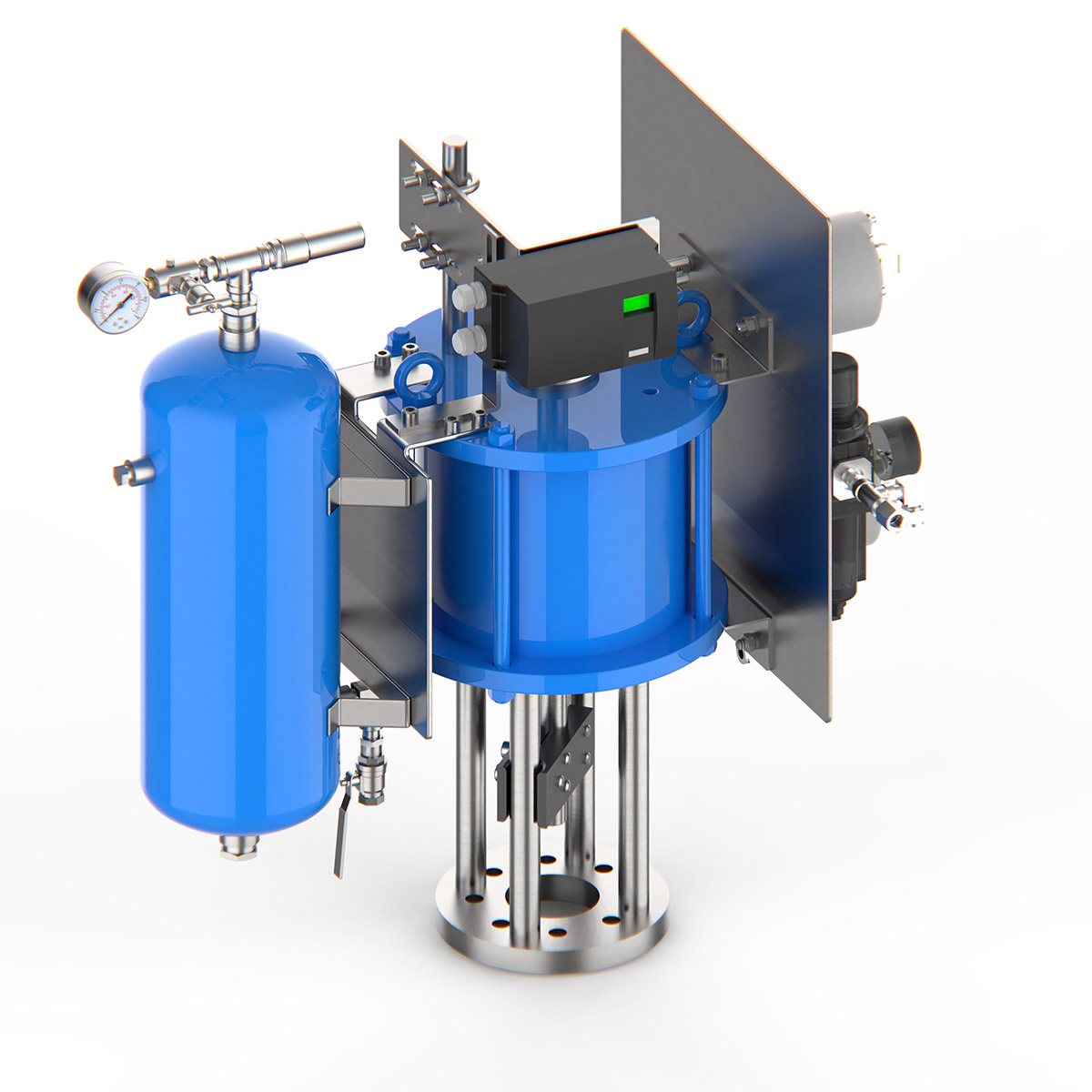
The BVT-PD is a linear pneumatic piston actuator from BVT Sweden for control valves and isolation valves in power plants, oil & gas installations and other steam and water applications. It is mounted on top of the valve, with a coupling connecting the actuator piston to the valve stem.
The BVT-PD is standard on BVT valves that use pneumatic actuation, and is also sold as an upgrade for existing valves. Each actuator is designed and built to match the force requirements of the valve and the customer’s stroke time, functional and environmental requirements.
- Type
- Linear pneumatic piston actuator
- Acting
- Double acting or single acting
- Operation
- Modulating or on/off
- Air pressure
- Max 10 bar(a)
- Sizes
- Up to 900 mm
- Fail-safe
- Fail open or fail close as standard
How the BVT-PD works
Air is supplied to the air filter regulator (AFR), which filters the air and limits the pressure to protect the valve and other components from overpressure. The positioner (P) uses a set-point signal from the DCS, typically 4–20 mA for 0–100 % valve opening, together with position feedback from the actuator to modulate the valve.
Volume boosters (VB) are added when the positioner alone cannot give the required stroke speed. They amplify the positioner signal and regulate the pressures in the cylinder. An optional position transmitter (ZT) reports the current valve position to the DCS, and optional limit switches confirm the end positions.
- AFR Air filter regulator
- P Positioner
- VB Volume booster
- PSV Pressure sensing valve
- D Directional valve
- AT Air tank
- ZT Position transmitter (optional)
- LS Limit switches (optional)
Design
The BVT-PD is a heavy-duty pneumatic cylinder built from chromium-plated carbon steel for corrosion resistance and low friction. A PTFE-charged slide keeps the piston aligned under all load conditions. The chromium-plated shaft, dynamic floating seals and PTFE-charged bushing reduce sliding friction and avoid stick-slip, giving low hysteresis and dead band for accurate control.
The actuator uses a through-rod cylinder, so the positioner and limit switches measure the position from above the cylinder. Electrical and control components are mounted on a plate on top of the cylinder, away from the high temperatures close to the valve, which improves their lifetime and makes them easier to reach. Smart positioners are standard, and the actuator can be designed for any brand of linear positioner, including linkage-free (magnetic) position feedback.
Applications
- Turbine bypass and steam conditioning valves
- Pressure reduction and process steam control valves
- Spray water control valves and isolation valves
- Upgrades of pneumatic actuation on existing valves
Specifications
| Types | Double acting or single acting; modulating or on/off |
|---|---|
| Maximum air pressure | 10 bar(a) |
| Standard operating temperature | −20 to 80 °C |
| Available sizes | Up to 900 mm |
| Component ingress protection | IP65 / IP67 |
| Cylinder corrosion protection | ISO 12944 C4 or ISO 12944 C5M |
| Tubes and fittings | ANSI 316 |
| Regulatory requirements | ASME, PED, ISO 9001 / 14001 as standard; ATEX and SIL as option |
| Cylinder material | Chromium-plated carbon steel |
| Hysteresis + dead band | < 4 % (control actuators, tested) |
| Linearity | Within ±5 % |
Default functions and options
| Default functions | Fail open or fail close at low pressure; air tank sized for 2 complete strokes; air filter regulator |
|---|---|
| Options | Quick open, quick close, or quick open + quick close; fail in place; limit switches; position transmitter; multiple solenoids in 1oo3 or 2oo3 configuration; SIL-certified components |
Key features
- Sized and designed to the customer’s valve forces, stroke times and environment
- Components calibrated and tested before shipping
- High linearity and small dead band
- Heavy duty for challenging applications and environments
- Positioner and electrical components installed away from the hot valve
- High corrosion protection (ISO 12944 C4/C5M) and ingress protection (IP65/IP67)
Quick and fail-safe functions
By default, the BVT-PD has a quick function (open or close) that overrides normal modulating operation and opens or closes the valve quickly if the supply pressure drops below a set level. The air pressure is monitored by a pressure sensing valve (PSV). If the PSV closes, the pilot signal to the directional valves (D) is shut off and the directional valves enable the quick function.
- Double-acting actuator: the quick function uses pressurized air stored in the air tank (AT), sized for two complete strokes. The PSV and directional valves redirect air from the tank so that the cylinder pressure does not fall below the minimum required level.
- Single-acting actuator: the fail action is handled by a spring on top of the cylinder. The directional valves depressurize the cylinder chamber opposite the spring, so the spring opens or closes the valve.
Optional solenoid valves (EV) can be connected in series with the PSV so that the quick functions can also be triggered from the DCS. Multiple solenoids can be arranged in 1oo3 or 2oo3 voting configurations.
Stroke time, dead band and stability
- Stroke time: control components are selected by simulation to handle the required modulating and trip stroke times, then confirmed by testing.
- Hysteresis and dead band: control actuators are tested so that hysteresis plus dead band is below 4 %, by opening and closing the actuator step-wise and comparing the actual position. Linearity is kept within ±5 %.
- Stability: volume boosters are tuned to reach the required stroke time while avoiding overshoot, which can cause instability.
Installation, commissioning and maintenance
The following summarises product manual M-019 and general instructions M-001. Always follow the full manual and local safety regulations.
Storage and handling
- Actuators are delivered on wooden pallets, wrapped in plastic with desiccant bags, sometimes already mounted on the valve.
- Store closed, dry and dust-free. For storage longer than 3 months, use a crate with waterproof coating. Outdoor storage is not recommended.
- Actuators over 25 kg have eye bolts for lifting. These are sized for the actuator only — never lift the valve with them.
Installation
- The drain valves on the air filter regulator and air tank must face downwards. Horizontal installation must be stated when ordering.
- Mount the actuator using its lifting lugs and connect it to the valve stem according to the valve manual.
Start-up
- Check that the stem coupling is installed correctly and the actuator is firmly fastened to the yoke.
- Check electrical connections and supply voltage against the supplied pneumatic diagram.
- Check that the air filter regulator gauge reaches the set pressure shown on the pneumatic diagram.
- Calibrate the positioner on site, then verify stable movement, end positions, stroke time and that no pressurized parts leak.
- Keep hands away from the coupling and stroke limiter when the cylinder is pressurized — there is a crushing risk.
Set points for the air filter regulator, pressure sensing valve and volume boosters are tuned at the factory and shown in the pneumatic diagram. Changing them may result in undocumented behaviour.
Functional testing
- Complete stroke test of the fail and quick functions every 12 months.
- Partial stroke test every 4 months, where the positioner supports it.
- During tests, check that the actuator does not move relative to the valve flange, that the full stroke is reached, that stroke time is within requirements, and that there is no external corrosion.
Frequently asked questions
- What is the BVT-PD?
- A heavy-duty linear pneumatic piston actuator from BVT Sweden, mounted on top of a control or isolation valve and coupled to the valve stem. It is standard on BVT valves with pneumatic actuation and is also sold as an upgrade for existing valves.
- How fast can a pneumatic actuator stroke a turbine bypass valve?
- Typically 10 seconds for a full modulating stroke and 5 seconds for a quick open or quick close (trip) stroke. Shorter stroke times can be handled on request. For the BVT-PD pneumatic piston actuator the achievable stroke time is set by the cylinder volume, the stroke length, the supply pressure and the flow capacity (Cv) of the pneumatic circuit, where the component with the smallest Cv limits the speed. Fast trip (quick open or quick close) strokes use air stored in an air tank sized for two complete strokes, and volume boosters are added when the positioner alone cannot give the required modulating stroke speed. BVT selects the components by simulation, confirms the stroke times by testing, and recommends a complete stroke test of the quick function every 12 months.
- What happens to the BVT-PD if the air supply fails?
- A pressure sensing valve detects the low pressure and directional valves drive the actuator to its safe position, using air from an air tank sized for two complete strokes (double acting) or a spring (single acting).
- What is the maximum air pressure for the BVT-PD?
- 10 bar(a). The air filter regulator limits the cylinder pressure to protect the valve internals.
- What sizes are available?
- Cylinder sizes up to 900 mm, sized to the valve’s force requirements and the required stroke times.
- How accurate is the BVT-PD?
- Control actuators are tested so that hysteresis plus dead band is below 4 %, with linearity within ±5 %.
- Which positioners can be used with the BVT-PD?
- Smart positioners are standard. The actuator can be designed for any brand of linear positioner, including linkage-free (magnetic) position feedback.
- Can the BVT-PD be fitted to an existing valve?
- Yes. The BVT-PD is sold as an upgrade for existing valves and is designed to match the force requirements of the valve.
- How often should the fail-safe function be tested?
- A complete stroke test every 12 months, and partial stroke tests every 4 months if the positioner supports it.
Download
- B-028 BVT-PD — datasheet, linear pneumatic actuator
- M-019 BVT-PD — product manual: installation, operation and maintenance
- M-001 — general instructions and safety
Contact BVT Sweden to request documents or a pneumatic diagram for a specific order.
Related BVT products
About BVT Sweden
BVT Sweden AB was started with the ambition of becoming world leading in critical applications in process steam and thermal power plant turbine bypass. Based in Säffle, Sweden, BVT Sweden employs experts with over 30 years of experience in turbine bypass, steam conditioning, temperature control, design and manufacturing processes. BVT designs turbine bypass valves and selects actuation to fit each customer’s requirements. Products are optimized on a per-order basis, and include steam conditioning valves, pressure reduction valves, stop valves, desuperheaters and spray water control valves.
Contact BVT Sweden for application-specific sizing and selection.